



Billions in Risk, and Opportunity, As Infrastructureless Future Approaches
July 16, 2026
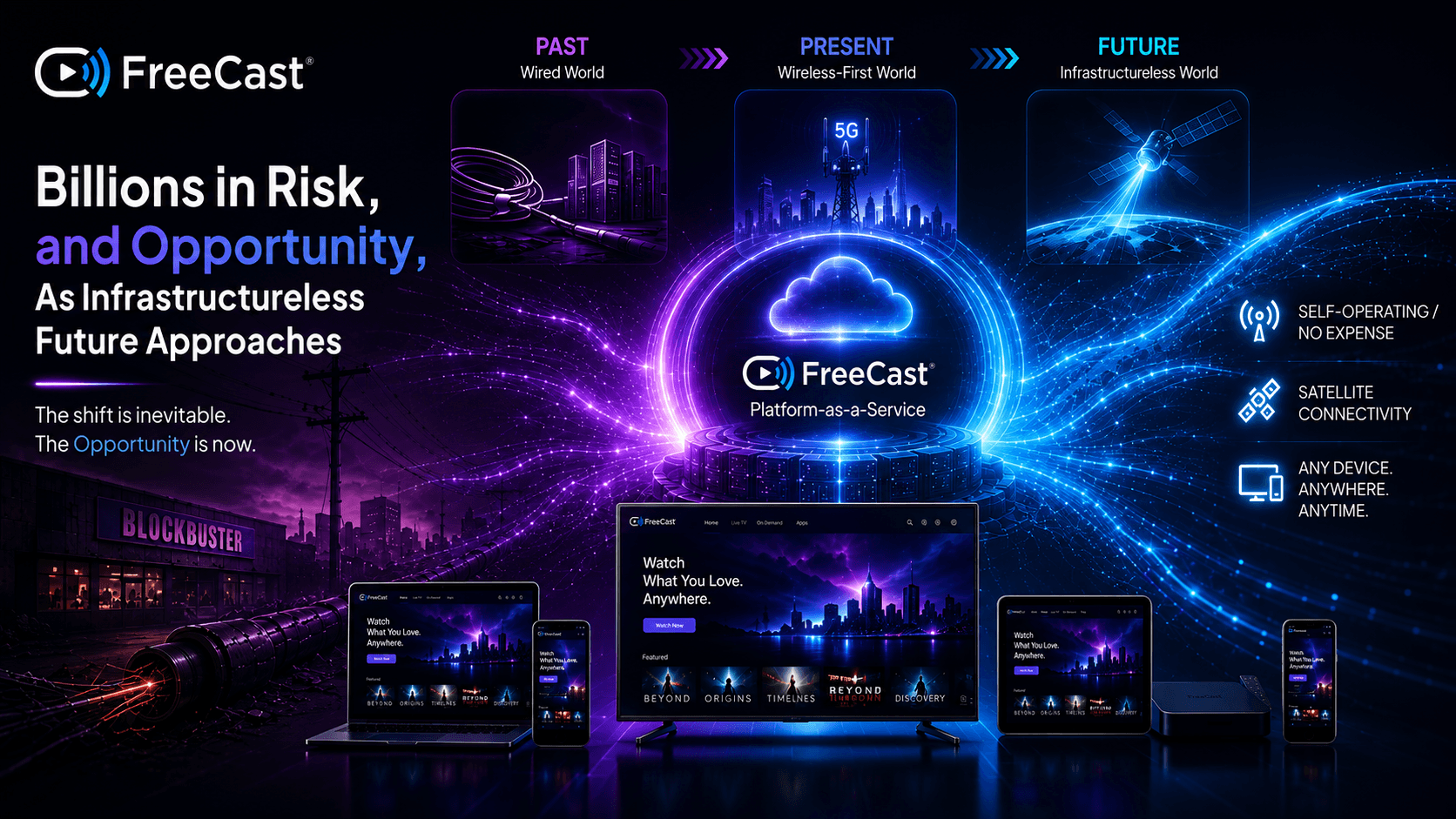
For nearly a decade, cord-cutting was a trend to watch. Impactful, yes, but a risk to be managed rather than a sea-change. In recent years, we’ve reached the tipping point, one that we arguably all knew was coming. As streaming began to over-take linear TV, suddenly the calculus across the media industry was changed.
Where there was once business as usual, there was now impetus for change. Thousands of firms realized their business models were built for a paradigm that was on the way out. Those that had embraced streaming had a strategy would still serve them; strategies built around linear TV were going nowhere but down. Once streaming was established as the new normal, the shift was accelerated precisely because it could no longer be ignored.
Now another shift of similar magnitude is on the horizon for the other half of the media industry. When looking at content and its distribution technology, the transformation of the industry is completing, with streaming’s primacy firmly established. But the same pattern is poised to play out again when it comes to the physical infrastructure.
Streaming has implications for business models (now direct-to-consumer dominates) and distribution technology (over-the-top services). The infrastructure shift will define “over-the-top” of what?
Terrestrial Infrastructure: The New Blockbuster?
What does a telephone pole or a cell tower have in common with a defunct video store chain? More than you think.
On the infrastructure side of the media industry, we’re moving towards a wireless-first world. 5G, and soon future wireless technologies, are fundamentally cheaper and easier to deploy than wired infrastructure, and generally more convenient too. The gaps in speed, reliability, and coverage are currently closing quickly.
With a wireless-first future in mind, building new cable infrastructure seems like a risky proposition. Cable companies and telcos have already begun to shed broadband subscribers as competition from wireless ISPs intensifies. Much like with streaming, we’re fast approaching a tipping point where wireless internet service becomes the norm. We see it coming, but once it arrives, it changes the economic calculus across the industry.
Suddenly, billions of dollars’ worth of costly infrastructure risks going under underutilized, maintenance costs become a massive disadvantage against wireless competitors, projects financed with debt may leave infrastructure owners owing more than their assets are worth and unable to cover interest payments.
This was precisely what happened to Blockbuster, whose model depended on delivering service via brick and mortar retail locations. Netflix provided the same service, without any of the overhead, using the mail and later the internet.
The Next Infrastructureless Horizon
Just as wireless internet technology is advancing rapidly, so too is satellite internet. While admittedly more speculative, over the next few decades satellite may reach the same status against terrestrial wireless that wireless is currently reaching relative to wired infrastructure.
This would mean direct, infrastructureless connection from satellite to home or even satellite to device, rendering physical towers as stranded assets in the same way. Consumer smart phones with satellite capabilities are already hitting the market. A world of devices with connectivity anywhere and everywhere by default is certainly somewhere between imaginable and inevitable.
What this has in common with the dilemma facing wired infrastructure operators is that the tipping point may be assumed, but its arrival is unknown. Investment decisions in the present must be weighted not only against this risk, but against evolving business trends before they are potentially inverted by a disruptive development.
As Dish Network parent EchoStar knows all too well, large infrastructure investments are often financed with debt, which creates a whole new layer of liability in the infrastructureless future: not just the cost of maintaining such infrastructure, but having debt obligations for impaired or obsolete assets.
The other risk that companies owning such infrastructure face is identical to the one their content-creating cousins faced: duplicated investment in distribution infrastructure. The old cable companies operated as regional monopolies. There was no need for Comcast, Charter, Time Warner Cable, Cablevision, and Cox all to build cables to the same houses.
This was the mistake of the Netflix-ization of the media industry. Everyone built their own cable in the form of a tech stack. In the wireless-first and satellite-first eras, the same risk exists for infrastructure investment.
Convergence Transforms Uncertainty to Opportunity
FreeCast’s Platform as a Service was designed to stop the unnecessary duplication of the technology stack that had sapped billions from the media industry. It also represents a sophisticated hedge against the uncertainty around infrastructure, because it is inherently physical infrastructure agnostic. FreeCast has the tech stack for over-the-top delivery, which works the same way however bandwidth is provided.
For today’s infrastructure owners, whether terrestrial, wireless, or satellite, FreeCast’s PaaS offers a way to increase revenue from current assets. In light of the futures outlined above, this moves beyond being a mere easy win or found money, into an economic imperative. For every piece of existing terrestrial infrastructure, an uncertain future means optimizing for maximum revenue from existing assets now makes more sense than expansion or network upgrades.
For programmers, and broadcasters especially, FreeCast’s PaaS solves the streaming distribution puzzle, while also de-risking the ongoing broadcast standard conflict. Rather than building a single tech stack, programmers can bypass those technology costs. They provide a single video feed, and FreeCast can make it available via ATSC 3.0, 5G Broadcast, HLS feed (for streaming), or DVB-T2.
For multi-family housing, the hospitality industry, healthcare facilities, student housing, and municipalities, FreeCast offers the opportunity to both reduce infrastructure costs when building and capture new revenues from existing communities. These organizations need not be content creators or traditional TV or broadband distributors to tap in to the revenue.
Likewise, the opportunity extends to brands and membership organizations that wish to provide a valuable service to their members and generate an additional revenue stream in the process. Organizations like AARP, Costco, any number of subscription businesses. The shared revenue from FreeCast’s Platform-as-a-Service could even make it an attractive fundraising tool.
The unifying theme for each of these business cases is that it allows FreeCast’s partner to focus on their core business. Whether that’s creating content, delivering bandwidth, providing housing, or serving a community of members some other way. They get all the advantages of offering a video service without any of the overhead. And for programmers currently in need of streaming distribution, it saves billions in costs by eliminating duplicative technology investment.