FreeCast Bypasses Broadcast Standard Confusion with Platform-Based Convergence
August 4, 2026
As we head into the second half of 2026, the future of broadcast television is as uncertain as ever. With ATSC 3.0’s failure to gain traction, 5G broadcast has emerged as an alternative, but thus far, inaction on all fronts has prevailed.
One component of that uncertainty is self-perpetuating: without a clear path forward, broadcasters are reluctant to make investments in either standard for fear of betting on the wrong horse. Rather than taking advantage of and selling the features of next-gen broadcast TV, the industry is instead stuck in a holding pattern while it waits on regulators to drive action.
This “wait and see” approach is the other side of the coin that is broadcast’s existential crisis. As digital distribution overtakes traditional linear TV, the very idea of over-the-air television is now under threat. Already smart TV platforms are steering users from local broadcast TV to FAST services for free linear television, and almost all new TVs sold feature some sort of smart interface or app manager.
Broadcast itself can no longer be taken for granted. In addition to the prevailing choice of inaction, a fourth alternative has emerged, which is that streaming FAST channels become the default for free television, making spectrum currently used for broadcast television an attractive target for repurposing by companies that would use it for wireless or satellite bandwidth instead.
The reality throughout the media business, amid sweeping and disruptive changes, is that doing nothing is as risky as making the wrong choice. This paralysis is a problem to be solved, not a strategy. Fortunately there is a smart path forward that minimizes risk regardless of the standard and regulatory environment: FreeCast’s Platform-as-a-Service.
Broadcasters Don’t Have to Become Tech Companies
We’ve already seen how the biggest companies in the media industry have responded to the shift to digital. Their playbook was essentially to become Netflix by launching a subscription video on-demand (SVOD) service. Billions have been spent on this effort, and going on roughly a decade since those efforts began, some of those services are just now starting to put some black on the ledger. Earnings calls are quick to tout that these streaming services are now “profitable” but that fails to account for the billions in sunk costs and years of losses prior.
This is a strategy that small media companies, like local broadcast TV stations in particular, simply cannot follow. Not only do they lack the resources, but even if they could, the results would be an absolute mess for consumers. Dozens of new apps and services to manages would only compound the frustrations with the current fragmentation of the ecosystem.
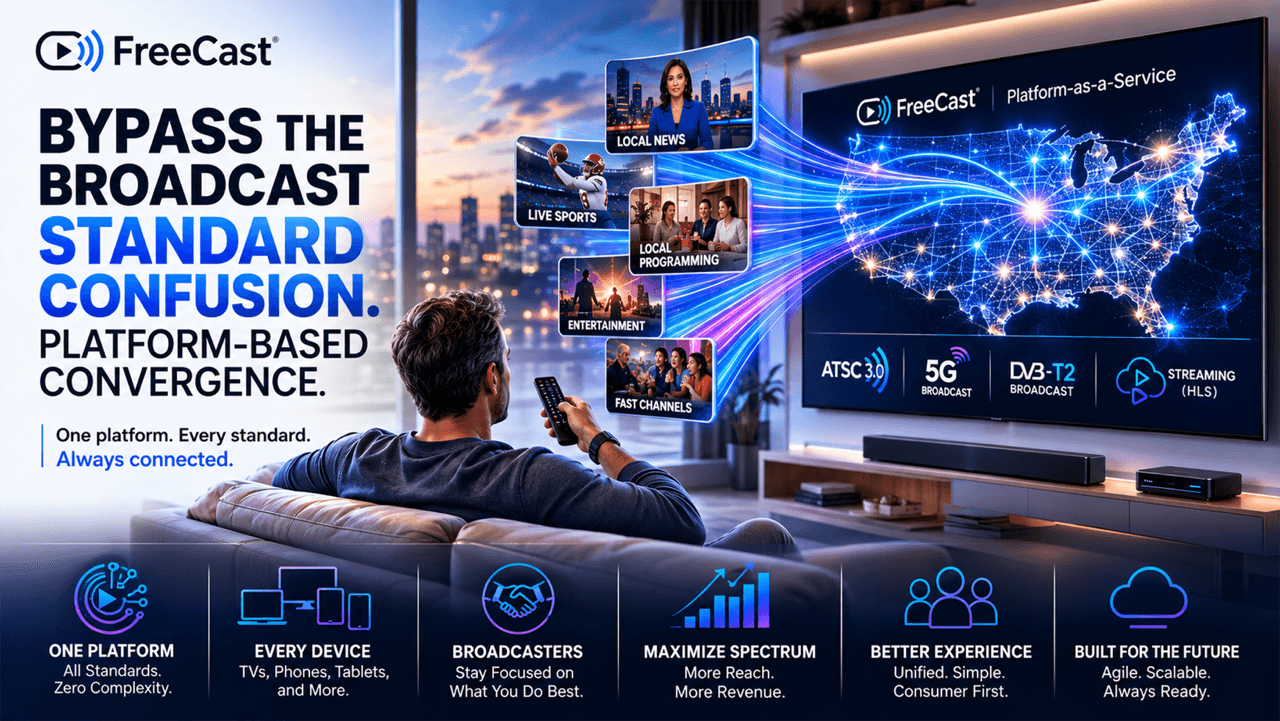
For broadcasters especially, FreeCast’s Platform-as-a-Service is the only solution that makes sense. Broadcasters that partner with FreeCast can turn one single linear feed into four formats, ready for transmission via ATSC 3.0, 5G Broadcast, DVB-T2, and web-based streaming distribution (HLS).
This eliminates not only the risk of selecting a single standard to support, but also saves these partners from the massive technology cost associated with transforming these feeds themselves, not to mention distributing them across different transmission technologies to a variety of different types of devices.
FreeCast makes this simple, with apps available on every major consumer device, and devices and infrastructure compatible with the various transmission options as well. FreeCast Home brings ATSC 3.0-delivered channels into the same interface with FAST channels, while the company’s Direct-to-Mobile technology uses 5G to reach consumers the very smartphones that are ubiquitous throughout the world.
Ready for the Regulators
Without consumers, broadcasters, or manufacturers embracing a new standard, the burden has fallen to regulators, specifically the Trump administration’s FCC. They face the option of either using mandates to push the moribund ATSC 3.0 standard forward, or keeping a hands-off approach, which could open the door for 5G Broadcast or leave the industry in its current quagmire.
Regardless of any decision on standards, the FCC under Trump-appointed chairman Brendan Carr has been a consistent frenemy to the industry. While Carr has advocated for a deregulatory agenda and other business-friendly policies, consistent with other Republican administrations, he’s also been confrontational and willing to wield regulatory powers towards particular ends. Politics has been front and center, with merger approvals often hinging on concessions around news coverage or DEI programs.
For broadcasters, the risk revolves around spectrum licenses, which have become a favorite tool of Carr’s FCC. Dish Network’s parent EchoStar was effectively forced to sell off their spectrum and exit the 5G wireless business, under threats from Carr who cited underutilization of the valuable resource. Broadcasters are vulnerable to the same allegation, and those who are not utilizing their spectrum could be at risk of losing it, whether they run afoul of the current administration, or another business makes the case that they could make better use of it.
FreeCast’s platform provides some security against this scenario. In addition to taking a broadcaster’s feed and making it available digitally, FreeCast can also do the reverse, providing FAST channels back to the broadcaster that are formatted to go out over the airwaves. Not only does this allow them to fully utilize their spectrum, but they can generate additional ad revenue from viewers who tune in to these channels over-the-air.
The Way Forward: Partnership and Platform
FreeCast’s platform offers benefits far beyond broadcasters. The questions around the broadcast medium come against a backdrop of broader changes in the media industry. Long-running trends towards streaming have recently reached a tipping point, with direct-to-consumer distribution overtaking traditional linear TV. Comcast and Warner Bros Discovery have responded by spinning off their cable channels, illustrating the magnitude of this shift. But even as linear TV declines, consumers remain frustrated with the number of apps and the rapidly-rising cost of subscription streaming.
The benefits FreeCast’s platform offers to broadcasters can also be applied to larger programmers. Streaming media becomes much easier to manage and thus more useable for consumers when distribution is centralized via a single platform, as was the case with cable TV providers for decades. This also benefits the media companies, by allowing them to focus on what they do best: making great content.
The recipe for profitability in today’s streaming-first media environment isn’t to hike prices or cut costs, it’s for media companies to get out of the technology business and stop paying upwards of $200 to re-acquire the same customer over and over again. FreeCast’s platform does this, by creating a single source for streaming content and giving users options to easily manage their subscriptions and media payments.
FreeCast has long pitched itself as an agnostic aggregator, and a neutral marketplace for content. But that doesn’t mean FreeCast’s role has to be a passive one. The company’s Platform-as-a-Service is an enabling technology, and FreeCast itself is inherently interested in the success of the media industry as a whole. Long-term success for everyone is going to come from tackling the cost and fragmentation problems head-on, which requires a shift from the walled-garden approach to a collaborative one, and no other company is as equipped to facilitate that as FreeCast.