



Scaling Up Smart with Virtual Infrastructure
October 7, 2026
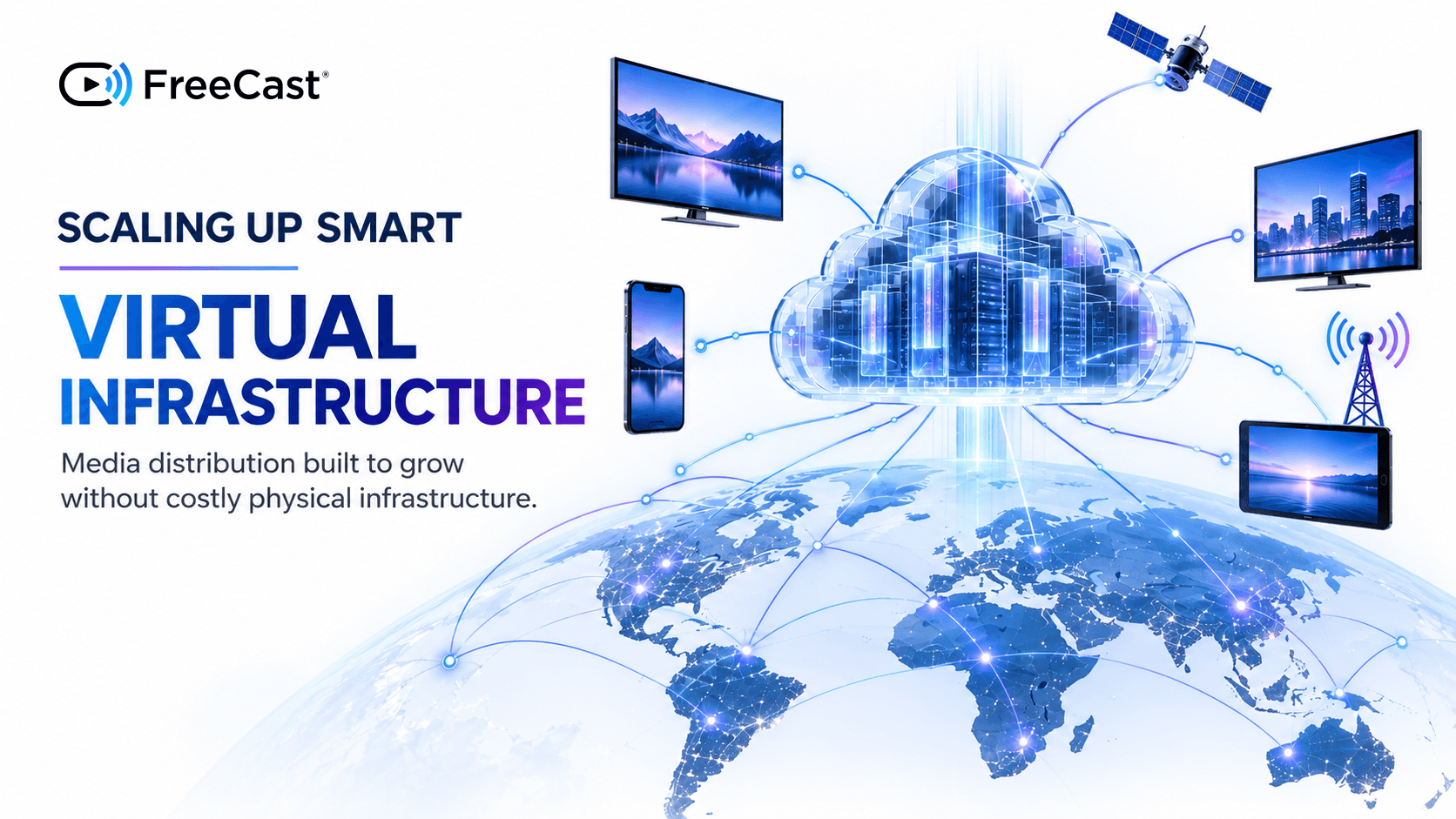
The media industry as a whole is entering a new era. The tipping point in television is perhaps the most visible example, with over-the-top streaming having taken over from cable and broadcast technologies, both of which depended on physical infrastructure. This is a shift from physical to virtual infrastructure, and it is likely to have ramifications well beyond the television business.
In the past, opportunities at this scale required massive investment. In the media industry, global telecoms and cable companies have spent trillions to build out the infrastructure to connect the world. In the tech industry, companies have spent billions to acquire users and achieve scale before turning their first profits. The most famous example is Amazon, "famously unprofitable" at one point, according to founder Jeff Bezos. It’s now one of the world's most lucrative companies, thanks largely to its physical presence, with warehouses and delivery vehicles in every community in the country. The winners of the last era had to buy their way to scale.
That equation is now changing. Media distribution is becoming bandwidth-centric, and the bandwidth itself is increasingly untethered from physical infrastructure. 5G wireless service is now widespread, and fixed wireless internet utilizing these networks has become a capable competitor to wired internet service. Satellite-based connectivity is rapidly going mainstream, with 6G and new broadcast standards also on the horizon. We're entering a world where bandwidth is delivered over the air, not through a cable, and that's going to change who the main distributors of what we think of as "television" are.
But a shift this significant risks upsetting the apple cart, destroying the value of incumbent media businesses, while creating opportunities for new players or those able to capitalize on the new dynamics of the market. For the telecoms of the world, strategic decisions today may well determine whether they play a critical role in that new OTT-first world, or find themselves owning a bunch of stranded assets that are rapidly declining in value.
Bypassing Expensive Terrestrial Investments
Some of the most important innovators of the modern era have one thing in common: they built businesses around what they didn’t need to do. Uber and Lyft realized they didn’t need to provide cars to be in the taxi business, their drivers already owned them. AirBnB and Vrbo didn’t need to build hotels, they leveraged existing homes to provide accommodations. In dozens of such cases, modern companies have found advantages over incumbents by using technology to reduce their dependence on costly physical infrastructure.
FreeCast’s Platform-as-a-Service approach operates on the same principle. Consumers already have access to broadband connections. This means that programmers don’t need to dive head-first into the distribution business.
However, in FreeCast’s case, this advantage need not be competitive with the connectivity providers, and in fact can be leveraged by them as well. While FreeCast takes advantage of existing infrastructure rather than requiring new build-outs, those infrastructure owners can share in the benefits just as the drivers and hosts of Uber, AirBnB and other such services do. In the telecom space, this is revolutionary. In addition to a mere subscriber fee, this gives these firms a potential stake in the economic activity that happens via their own connection, for perhaps the first time ever.
This is a potent new revenue stream that scales up with size, while importantly not scaling up in cost to deliver the service. With the tech stack and commercial relationships already consolidated and in-place, the cost to FreeCast to serve a thousand new subscribers or a million is negligible. And because FreeCast’s PaaS monetizes consumers’ TV habits, it’s almost immediately revenue positive in every scenario in which it’s utilized.
The Foundation for Future Growth
This approach is context for understanding FreeCast’s financial situation. Among tech companies, it’s not uncommon to have a long period of great investment before pivoting to profitability. In the streaming space especially, this has been common. Most streaming services are just starting to put small profits on the balance sheet, but are far from any real ROI when considering the billions in investment and years of losses required to reach that point.
The ability to scale from the current foundation is what sets FreeCast apart. In the case of the other streaming services, profitability has come at the expense of growth, with skyrocketing streaming prices padding the bottom line, but also exacerbating many of the streaming industry’s most stubborn problems: churn and customer acquisition costs.
FreeCast’s PaaS on the other hand was designed specifically to bypass this very problem. By leveraging commercial partnerships, FreeCast is able to bring in thousands of users at a time, at very low cost, rather than paying to acquire them via traditional marketing. Because the FreeCast service is then bundled with one’s bandwidth or housing, it’s not subject to the “binge and bounce” tactics or churn that plague the big SVOD providers.
FreeCast’s current run rate is the foundation needed to provide the service. As growth accelerates, that foundation remains, without costs that explode at a similar rate. By providing an aggregation technology, FreeCast again bypasses one of the most costly parts of the process: creating or licensing content.