Streaming Sports Require a Rethink Around Sustainability
August 7, 2026
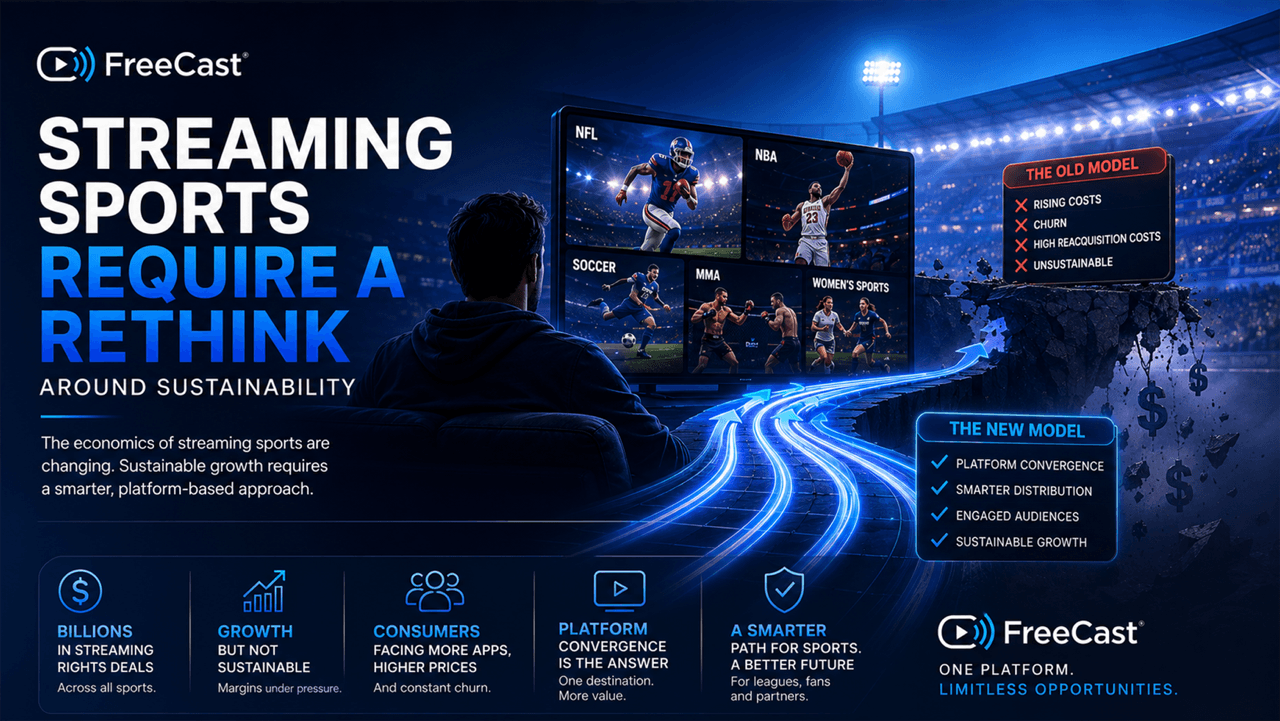
After years of stubbornly sticking with their highly lucrative cable TV distribution partners, streaming’s overtaking of linear TV has finally prompted major league sports to make the jump to streaming as well. This coincides with and is largely driven by the collapse of sports’ long-time cash cow: Regional Sports Networks.
It may be tempting to view the struggles of various sports cable channels as isolated, a symptom of the decline in linear TV, but not an existential threat beyond the RSNs themselves. While some teams have been left in the lurch, forced to find new distribution options, sports remain the most premium type of content on the air, commanding astronomical fees.
As sports leagues have begun to strike streaming rights deals with major SVOD services, the business of professional sports seems as healthy as ever. Competition among streaming services for these sought-after sports leagues has helped continue the skyrocketing costs for professional sports.
This rising tide appears to be lifting all sports boats. It’s not only the major leagues that are striking big deals. Soccer, MMA, motorsports, and even women’s sports have all been showered with rich streaming rights deals.
At first glance, it may seem like RSNs will simply disappear from the picture, as major streaming services take their place with minimal disruption to the sports leagues or consumer sports fans, barring the occasional bump in the road for individual teams whose current RSN distribution is disrupted.
But what’s actually happening is the convergence of two trends that could indeed upend the economics of streaming sports as we know them. Much like with the shift of other types of content from traditional television to streaming, the same sort of trade-off is on the horizon: highly profitable wholesale distribution giving way to costly retail distribution, with lower margins, super-charged churn, and massive costs to reacquire the same customers over and over again.
Many streaming services have viewed sports as their “must have,” a silver bullet that has necessitated the current streaming sports arms race. In reality, the current economics are perhaps the least resilient to this type of disruption. Something’s got to give.
The End of the RSN Sports Subsidy
To understand the threat to the viability of streaming sports, we must first look at what made sports so wildly profitable on cable via RSNs.
Sports were the biggest beneficiaries of cable bundling arrangements. Across the media industry, these bundles subsidized all types of content. Most consumers only ever watched a handful of the cable channels they paid for, but with no à la carte pricing, they were forced to pay for hundreds. Each of those hundreds of channels came with a guaranteed monthly subscriber fee regardless of whether a cable customer watched even a minute of them.
While sports were often among the pillar programming that forced consumers to keep paying up for those bloated bundles, they were handsomely rewarded for it. Sports channels were among the most expensive, and notoriously so. ESPN was cable’s most expensive channel, commanding a fee greater than the next 4 top channels combined. RSNs were likewise priced high, often leading to disputes with distributors over fees.
But as consumers abandon cable TV, this once reliable revenue stream is drying up fast. This is particularly problematic as many sports TV rights deals were signed for years-long terms. For example, then Time Warner Cable’s SportsNet LA become the exclusive home of the LA Dodgers on a 25 year deal. The economics of that arrangement were controversial at the time of its signing, and that was more than a decade ago in 2014. Not even half-way into that contract term, it’s a financial disaster that illustrates why so many RSNs are failing.
The Voodoo Economics of Streaming Sports
It’s easy to understand the pickle that RSNs are in given the decline in linear TV revenues. Less talked-about but just as clear is the tough math surrounding streaming sports deals.
George H. W. Bush made the term “voodoo economics” famous, referring to proposals from rival Ronald Reagan in the 1980 presidential election. This spooky term refers to economic policy that has no logical connection with its intended outcome. Reagan contended dubiously that that steep tax cuts would produce so much economic growth that the cuts would “pay for themselves.”
The reality of course was much more intuitive: all else being equal, collecting less tax revenue results in a larger deficit, not a smaller one, and Reagan’s fiscal policy doubled the national debt.
We see the same logic at play among the big media companies who are rushing to secure massive sports streaming rights deals. To see the financial problem with these spendy sports deals requires only a calculator. Simply divide the yearly cost of the deal by the number of subscribers, then by twelve, and you get how much the streaming service in question would have to raise prices by, just to break even. Note that this “breaking even” also requires that the service not shed subscribers with the price increase.
For Peacock, which signed a $27.5 billion deal with the NBA for basketball games, the problem is particularly acute. With 36 million subscribers, a price hike of $5.79 would equate to a more than 50% increase. Once again, basic economics rains on the parade. If you remember learning about supply and demand in Economics 101, you should know that as the price of something increases, the quantity sold decreases. Peacock would need 3 new subscribers drawn in by NBA games for every 2 subscribers who cancel over the price increase for this to even begin to make financial sense.
Moving on to Disney, the picture is more complicated, but not much better. While Disney and its Disney Plus app are synonymous with children’s movies, it’s ESPN Plus service is equally synonymous with sports. If Disney’s NFL games are exclusive to ESPN Plus, the cost would have to almost double, from $11.99 to $20.99 per month, without shedding subscribers, to break even. Spreading this cost over Disney Plus’s approximately 150 million subscribers would bring this number down to a dollar and change, but would effectively do so by having families unwittingly subsidizing sports fans. And even a more modest price increase would still cost the service some number of subscribers.
For Paramount Plus, and their smaller UFC deal, this subsidy problem is even more pronounced. With a starting price of $7.99, even $1.18 per subscriber would equate to a 15% price hike. While UFC is certainly popular, mixed martial arts are a niche sport without the broad appeal of the big four sports leagues. For some segment of Paramount’s subscribers, getting MMA fights that used to be an $80 pay-per-view purchase for just over $1 per month is a steal, but the vast majority are left footing the bill for content they don’t want. Women or families probably won’t be thrilled to find out they’re paying more because combat sports are now a required part of the package.
For all three, even this harsh math is made worse by the ongoing problem of “zombie subscribers” who are counted among these services’ subscriber numbers, but don’t contribute any additional revenue and effectively don’t shoulder any effects of a price increase.
Ultimately these deals won’t recoup costs through fee increases alone. But with the magnitude of the costs here, there’s just no practical combination of price hikes and ad revenue for these deals to have a positive ROI any way you slice it. This is likewise compounded by the “zombie subs.” All of these subscriber figures include potentially millions of subs who do not use the service at all and thus contribute zero ad revenue.

The Sports Bubble is Unsustainable
As was the case with cable TV, the cost of sports programming cannot simply continue to skyrocket indefinitely. Eventually that trend is going to collide with the reality that the economics no longer support it.
When that happens, one of two things will follow, and neither of them is good.
Either distributors will put their foot down to reign in prices, only signing deals that make economic sense (i.e., far below current costs), or we’ll see a repeat of the RSN crisis, with the burden of these massive streaming sports deals destabilizing the services that distribute them.
In either case, sports leagues can kiss the days of a blank check goodbye, and will themselves have to adjust their product to match what the market can support economically.
The time to act on that is now, before it becomes a full blown crisis with the potential to leave leagues holding the bag or blow holes in the balance sheets of the nation’s largest media companies.
While sports teams and leagues may be content to accept those big checks from Comcast, Disney, Paramount, and others, so too were those very companies when it was Netflix writing the checks. Their short-term gain eventually grew into something that disrupted their business.
Rather than put their fate in the hands of the big SVOD operators, and hinge their own economic fortunes on the ability of these legacy media companies to pull off a miracle when the math doesn’t add up, sports leagues should take a more active role in their own distribution. This will allow them to find balance without the risk of another RSN-style crisis.
Leagues will also be able to avail themselves of new monetization options, adding new revenue sources rather than trying to split scarcer ones with a middle-man distributor.
There’s millions of sports fans in this country, and that’s a tremendously lucrative opportunity, but only if those fans can easily and affordably access the games they want to watch. If it becomes too expensive or too burdensome, everybody loses. And that’s precisely what’s at risk of happening now, as more games become spread across paywalled sources, requiring multiple paid subscriptions to access.
Rather than needing half a dozen streaming services, which could soon be charging north of $25 per month each as they struggle to absorb the cost of their sports deals, hybrid monetization makes more sense. A low subscription fee, paired with advertising (and particularly local leads-based advertising), merchandising, viewer data, sports betting, and fan engagement efforts.
FreeCast’s Regional Streaming Sports Channels offer one such solution. This is FreeCast’s ethos when building products: we believe in addressing the structural challenges impacting the entire market. Regional Streaming Sports Channels are designed around creating something sustainable for the long term with multiple revenue streams, making sure consumers have access to their sports, and giving teams and leagues the control they need to avoid being tied to unstable partners via multi-billion dollar rights deals.
Together these monetization approaches may not match the heights of “bubble era” sports programming deals, but they do offer a stable and sustainable path forward where leagues and teams across the nation can make money and avoid becoming downstream victims of a financial crisis.