AI and Streaming in 2026: How Artificial Intelligence Is Changing Entertainment Discovery
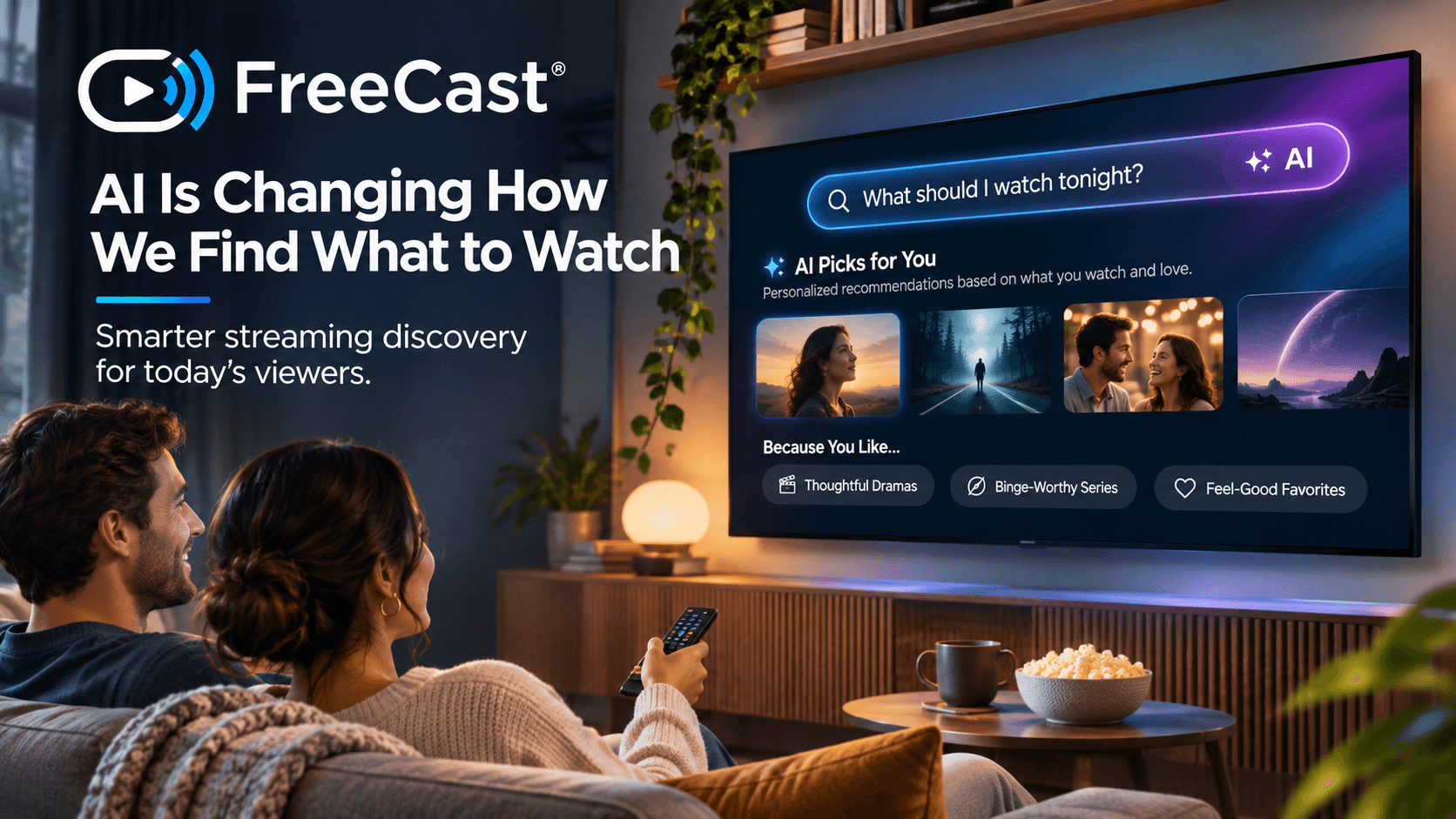
Streaming has no shortage of content. The harder problem is finding the right thing to watch.
That problem is getting more attention in 2026 as artificial intelligence moves deeper into entertainment discovery. Netflix is testing new AI-assisted ways to narrow recommendations. Roku is using AI to personalize what appears on the home screen and explain why certain titles are being surfaced. Amazon has experimented with AI-generated content topics, while Google is bringing Gemini directly into the television experience.
The bigger story is not that streaming companies have found another place to add AI. It is that the industry is beginning to rethink one of streaming's most persistent frustrations: how viewers move from “I want to watch something” to actually pressing play.
For viewers, that shift could eventually matter as much as another new streaming service. For platforms, it creates a new competitive question. The next battle in streaming may be less about who has the most content and more about who can understand what a viewer wants, identify where the right content is available, and get that viewer there with less friction.
Finding Something to Watch Has Become a Streaming Problem
The streaming boom gave viewers more choice, but it also spread television, movies and sports across a growing number of subscriptions, free services, apps and devices. The result is a discovery problem hiding inside a content abundance problem.
In Gracenote’s 2026 State of Play research, released by Nielsen on November 12, 72% of streaming viewers surveyed said they want a single program guide that brings together everything available across the services they use. Among viewers ages 18 to 24, that rises to 78%. More than one in four respondents said they often or always miss a show, movie or sporting event because they cannot find it.
The business implications are just as important. More than half of respondents said they would be likely to cancel a service if they could not find programming that interests them, and 87.4% said user experience is important when deciding which services to keep. Discovery is no longer a small interface problem. It can influence whether someone watches, leaves or pays.
The same research found that nearly 35% of respondents are spending more time with free ad-supported streaming because the subscription landscape feels overwhelming. Nearly 47% said the sheer volume of content and services sometimes pushes them back toward shows and movies they already know instead of discovering something new.
AI Is Becoming Part of How Viewers Decide What to Watch
At the same time, viewers are becoming more comfortable asking AI for help. In a separate Gracenote study on AI-powered entertainment search and discovery, 66% of respondents said their use of AI chatbots had increased over the previous 12 to 18 months. More importantly for entertainment, 57% said these tools could become, or already are, their preferred way to get information about why, where and when to watch content.
The attraction is easy to understand. Traditional search works best when someone knows what to type. Entertainment decisions are often fuzzier. A viewer might remember an actor but not the title, a scene but not the show, or simply know that tonight calls for something funny, short and appropriate for the whole family.
AI is better suited to that kind of ambiguity because it can interpret context, follow-up questions and intent. The same Gracenote research found that respondents preferred chatbots over traditional search for complex questions and follow-up questions. But there is an important counterpoint: traditional search still scored higher for trustworthiness and accuracy. That tension between usefulness and reliability is going to shape the next phase of entertainment AI.
The Industry Is Moving From Recommendation Engines to Active Discovery
Streaming recommendations are not new. For years, platforms have ranked titles based on viewing history, likes, completion rates and other behavioral signals. What is changing is the viewer’s role in the process.
Instead of an algorithm quietly deciding what belongs in the next row, AI can give viewers more ways to shape the recommendation itself. That shift is already visible across some of the largest names in streaming.
Netflix: From Silent Ranking to Steerable Discovery
Netflix introduced AI Discover on November 3 as a limited test on supported TVs in the United States. Rather than beginning with an exact title, viewers can start from a theme such as “Something Light,” “Family Movie Night” or “Quick Watches,” then narrow the recommendations until something feels right.
Netflix’s engineering team describes the change as a move toward steerable discovery. The significance is not simply that an LLM is involved. Netflix is combining AI with its existing recommendation, catalog and safety systems so that generative technology helps understand intent without being allowed to invent titles or ignore availability.
That is an important distinction for the industry. The goal is not to replace every proven recommendation system with a chatbot. It is to use AI where it adds something traditional ranking systems do not: the ability to listen to what a viewer wants now, not only infer what that viewer may want based on the past.
Roku: Personalization With More Explanation
Roku is taking a related approach. Its current OS features include an AI-powered personalized row of shows, movies and live events. Search results can also include tailored explanations for why particular entertainment is being shown, based on viewing preferences, watch history and trending content.
That points to another useful direction for AI: explainability. Viewers may be more willing to trust a recommendation when the platform can communicate why it fits. “Because we think you will like this” is less useful than a recommendation connected to the viewer’s mood, interests or prior choices.
Amazon: Organizing Entertainment Around Interests
Amazon has also experimented with AI as a discovery layer. Prime Video’s AI Topics uses large language models and Amazon Bedrock to create content groupings based on interests and viewing history, with examples such as “mind-bending sci-fi” or “fantasy quests.” Viewers can move through related topics to refine what they want.
The idea matters because entertainment has traditionally been organized around relatively rigid categories such as comedy, drama, action or documentary. AI can create a more flexible layer around those categories, incorporating tone, theme, situation and intent.
Google TV: Making the Screen More Conversational
Google is moving conversational AI directly onto the television. Gemini for Google TV expanded the TV experience beyond simple voice commands by allowing more free-flowing conversations and recommendations. In 2026, Google added richer visual responses, sports information and where-to-watch information on supported devices.
This is another sign that the television itself is changing. The screen is becoming more than a place to launch apps. It is becoming an interface that can interpret a request, supply context and help narrow a choice.
The Next AI Challenge Is Bigger Than One Streaming Library
Each of these approaches addresses a real problem, but another problem remains: viewers do not experience streaming as one library.
A household might use Netflix for one show, Prime Video for another, a free streaming service for live channels, a separate app for sports, and yet another service for local television. A recommendation can be excellent and still fail if the viewer cannot tell where the program is available or whether access requires another subscription.
That is why the 72% figure from Nielsen matters so much. Viewers are not only asking for better recommendations inside individual services. They are asking for a more unified way to understand a fragmented entertainment market.
This also changes the competitive landscape. Netflix can become better at helping someone find Netflix content. Prime Video can improve discovery across Amazon’s ecosystem. Google and Roku can use their positions on the television interface to connect more pieces. But the broader opportunity is to help viewers move across entertainment sources without making the complexity of the market their problem.
AI Recommendations Are Only Useful If the Entertainment Data Is Right
There is also a less glamorous part of AI discovery that may prove just as important as the model itself: accurate data.
In Gracenote’s 2026 AI accuracy study, researchers tested an ungrounded large language model across 2,600 popular movie and television titles in 13 countries. For 506 titles, nearly one in five, the model fabricated every measured metadata attribute.
That finding should be a warning for anyone building AI into entertainment. A recommendation that sounds perfect but points to the wrong movie, the wrong actor, an outdated catalog or an unavailable service is not a better discovery experience. It is simply a faster way to create frustration.
The future of entertainment AI therefore depends on more than a conversational interface. It depends on grounding AI in trustworthy content intelligence, current availability data and systems that know what the viewer can actually watch.
What Should the Best AI Streaming Experience Actually Do?
As AI becomes more common across entertainment platforms, the industry will need a better definition of success than simply “we added AI.” A useful discovery experience should solve real viewer friction.
- Understand intent, not just keywords. A viewer should be able to describe a mood, a memory, a theme or a situation without knowing the exact title.
- Let the viewer steer the recommendation. “Something newer,” “make it shorter,” or “nothing too dark” should refine the choice instead of restarting the process.
- Know what is actually available. Discovery should be connected to current catalog and availability information, not just a plausible answer generated from old training data.
- Distinguish free, subscription and transactional options. The answer to “where can I watch it?” is incomplete if it ignores how much access costs.
- Work across entertainment sources when possible. Viewers increasingly think about programs first and services second.
- Reduce the time between intent and playback. The best discovery experience is not the one that generates the most recommendations. It is the one that helps the viewer find a good choice and start watching faster.
That last point may become the most useful way to judge AI in streaming. The real metric is not how impressive the conversation sounds. It is whether the technology reduces the distance between “What do I want to watch?” and “Press play.”
Where FreeCast’s True Voice AI Fits
FreeCast is approaching the same discovery problem from a cross-service perspective. The company introduced True Voice AI on November 16, with testing already live on FreeCast’s web interface and integration into the Watch App planned as the experience develops.
The important distinction is that this is not simply traditional voice search with a new label. The idea is to let viewers use their own natural language, their “true voice,” to express what they actually want to watch. That could begin with part of a title, an actor, a remembered scene, a storyline, a sport or simply the kind of entertainment the viewer has in mind.
FreeCast’s larger opportunity is that discovery does not have to stop at the edge of one studio or streaming library. The company’s public description of True Voice AI emphasizes finding entertainment across supported streaming services. That fits a broader FreeCast strategy built around helping viewers navigate free channels, movies, television, sports and other viewing options in one place.
That approach also connects naturally with FreeCast’s Best Free TV Streaming Services in 2026 guide and the broader FreeCast channel directory. The common thread is not simply more content. It is helping viewers understand their choices.
FreeCast does not need to claim that its approach replaces what Netflix, Roku, Amazon or Google are building. The more interesting position is that all of these companies are attacking different pieces of the same problem. FreeCast’s lane is the increasingly important space between viewer intent and a fragmented collection of places to watch.
The Competition May Shift From Owning Content to Owning the Discovery Moment
For most of the streaming era, competition has centered on content libraries, exclusive programming, price, bundles and subscriber scale. AI introduces another battleground: the discovery moment.
If a viewer asks an AI assistant, a smart TV or a streaming platform, “What should I watch tonight?”, the company that owns the answer does not necessarily own the movie or show. It owns the moment in which the viewer decides what happens next.
That is why AI discovery could matter beyond the largest subscription services. Platforms that can accurately connect intent, recommendation, availability and access may have an important role even when they do not finance the original program themselves.
The shift is already visible outside streaming apps. Nielsen’s research shows that consumers are increasingly comfortable using general-purpose AI chatbots to ask entertainment questions. That means discovery is no longer confined to the home screen of a streaming service. Google, ChatGPT, Gemini and other AI tools are becoming part of the path to viewing.
What This Means for Viewers in 2026
For viewers, the most meaningful AI improvements may be the ones that feel the least technical. People are unlikely to care which model generated a recommendation. They will care whether it understood the request, whether the recommendation was relevant, whether the availability information was accurate and whether they could start watching without another search.
That creates a useful standard for the industry. Good AI should make entertainment feel simpler, not add another layer of complexity. It should give viewers more control over recommendations, not just more recommendations. And it should respect the reality that entertainment now lives across paid subscriptions, free ad-supported services, local television, live sports and transactional options.
For companies building these experiences, the challenge is equally clear. AI has to be grounded in reliable data, connected to real availability and designed around viewer intent. A clever answer is not enough.
The Future of Streaming May Be Less Searching and More Watching
The streaming industry spent years competing to put more content in front of viewers. The next phase may be about helping people make sense of all that choice.
Netflix’s AI Discover, Roku’s AI-powered personalization, Amazon’s interest-based topics, Gemini on Google TV and FreeCast’s True Voice AI are different approaches, but they point in the same direction. Discovery is becoming more contextual, more interactive and more important to the overall streaming experience.
The companies that stand out will not necessarily be the ones that use the most AI. They will be the ones that use it to solve a problem viewers already have.
The future of streaming discovery is not simply about using artificial intelligence to recommend more content. It is about understanding what viewers want, identifying where that content is actually available and shortening the distance between deciding what to watch and pressing play. In an entertainment market defined by abundance, that may be the next real competitive advantage.