The Next Trend to Watch: A Shift Away from "Full-Stack" Media
September 24, 2026
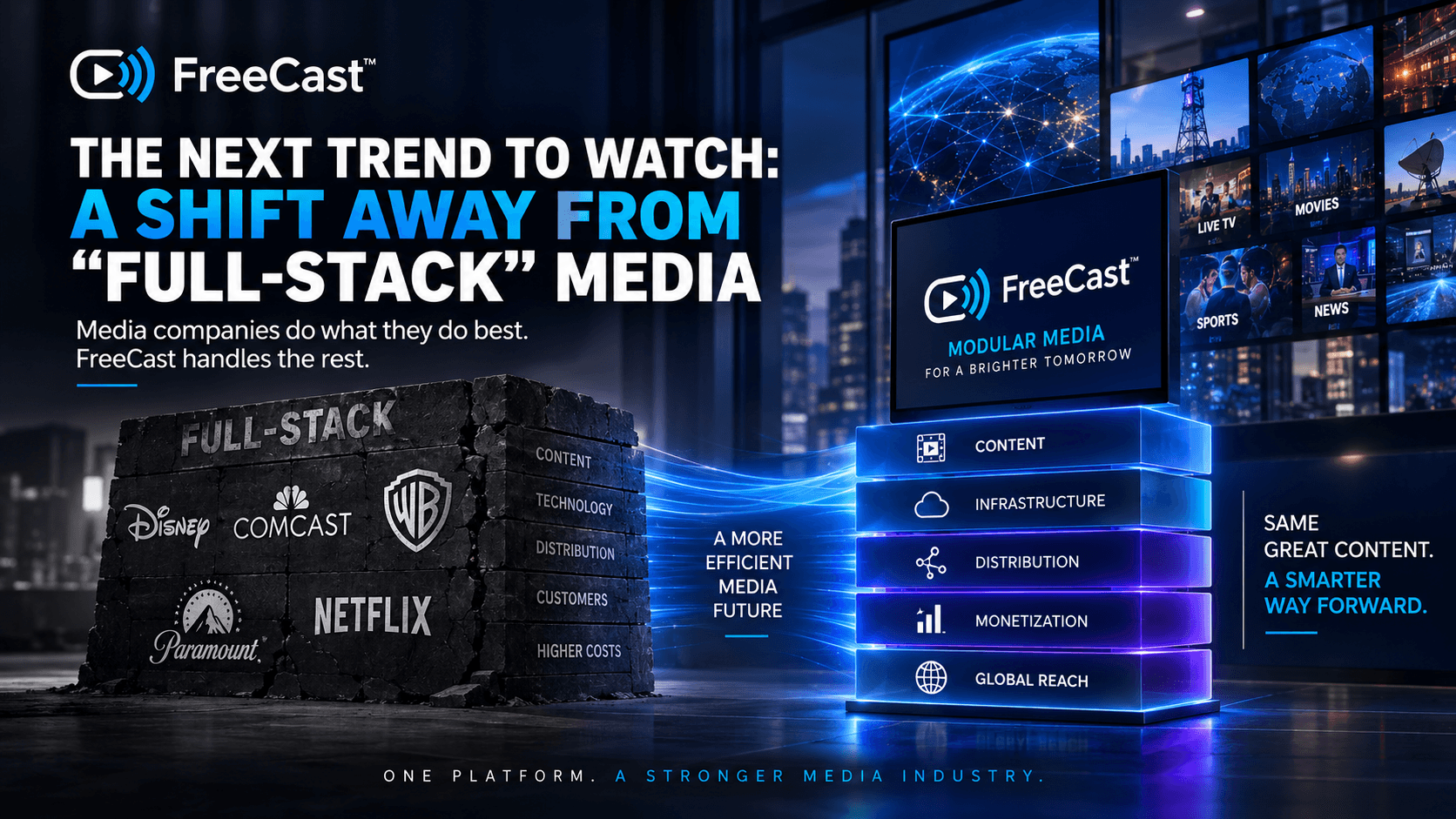
Ever since cord-cutting began to darken the media industry's horizon, the biggest players have been under pressure. Linear TV was on a slow decline, which was poised to (and did) become rapid, taking billions of dollars in media industry revenue with it.
While the trend line was clear, what to do about it wasn't. Thus the industry looked to the source of the disruption: streaming, as popularized by Netflix, Amazon Prime, and Hulu. Rather than let these services eat their lunch, the big media empires decided to try and beat them at their own game.
To do this, Comcast, Disney, Warner Bros. Discovery, Paramount, and others effectively had to transform into tech companies, building their own version of Netflix in-house. Instead of Netflix, Amazon, and Hulu handling the tech and distribution, each big player duplicated these technology costs, to the tune of billions of dollars. They were creating something that already existed, but they felt that they needed to own it rather than rely on tech firms that were increasingly seen as potential competitors in waiting.
Fast forward to 2026 and that strategy has not aged well. While the media firms are eager to tout the first profits from their streaming investments, the little bit of black on the ledger is dwarfed by the decade of investment to get there.
Rethinking Vertical Integration
Kirby Grines of 43Twenty highlighted the core problem in a post on LinkedIn: owning the full stack is an expensive luxury that has largely failed to justify itself.
Now with streaming having overtaken Linear TV, the media industry is at a crossroads. The industry giants were the first movers, they had the most to lose and the resources to try and build a new future. But the next wave will be different from the first: mid-sized and smaller firms both lack the resources to build their own technology, and have watched the strategy fail to deliver for the bigger players. Likewise, despite billions in sunk costs keeping them from calling it a failure, the industry leaders are likely on the lookout for more effective strategies and could be tempted to change course.
As unlikely as that seems, it grows more likely every day. Comcast is exiting the media business by spinning off NBCUniversal; for both companies, it believes less is more. A Wells Fargo analyst recently suggested that Disney, long considered a leader among the legacy media streaming players, should exit the streaming business entirely. Paramount's quest for size and scale, with its years-long determination to merge with rival Warner Bros. Discovery, could yet prove to be a bust.
All this reflects something that FreeCast has believed for a long time: America's media companies should stick to what they do best, which is creating content. This is also the rationale behind FreeCast's Platform-as-a-Service. With a plug-and-play streaming distribution stack, these firms can get themselves out of the technology and distribution businesses.
This is a return to a winning formula, and one that worked well for decades. It mirrors the cable TV distribution arrangement. Cable companies built a single conduit to each household and managed the distribution of dozens of rival programmers. This allowed for a superior wholesale distribution model, avoiding the high churn and customer acquisition costs that continue to plague today's streaming business.
Owning the Right Pieces Without Fumbling the Rest
A simple fact is driving the turn away from the "full stack" approach: Some pieces of the streaming value chain are more lucrative than others. The prior misconception was that one had to own the whole chain to capture those most-valuable pieces. With the shift away comes the challenge of how to divest while keeping the chain intact. This, more so than pride or inertia, is the bigger blocker for firms that have already built their own Netflix.
The technology behind streaming is complex; it takes dozens of different technologies, vendors, and business relationships. FreeCast spent the better part of a decade and more than $50 million assembling all these necessary pieces to be able to offer them together as shared infrastructure. But this also means that picking and choosing parts quickly becomes a complicated affair.
Missing or mishandled pieces can break the whole arrangement, and a disjointed experience from the consumer perspective also does more harm than good. For anyone to offload less attractive pieces of the business, a reliable and neutral third party is a necessity.
That's where FreeCast comes in, as a shared infrastructure provider. In addition to the savings, the company's position as a key conduit or backbone allows it to credibly offer services to a multitude of firms that would otherwise avoid partnering with one another.
It's also why FreeCast's formula is unique. Even a company with massive resources like Google, Amazon, Disney, or Comcast couldn't simply spend the same $50 million and offer the same service. That would require tech and media firms to trust their own direct competitors to handle their content without favoring their own, and also faith that such a product would remain available even as economic winds shift.
With a neutral infrastructure provider, content providers don't have to worry about a tilted playing field or incentives for the provider of a key service to pull the plug.
FreeCast Enables Modular Media
The other critical piece here is modularity. Big media firms owned the full stack because they had to; that was the price of entry. The pieces they added on to their businesses are the ones that are now plagued with problems. Owning the customer relationship means being subject to churn, customer acquisition costs mean millions in marketing spend to reacquire the same customers again and again.
For a local broadcaster or Diginet, going this route is not a viable option. The modular approach means they can access only the pieces they need, whether that's purely a FAST end-point, or a more sophisticated setup that extends their reach with VOD, paywalls, geo-fencing, and other features.
This also opens the door to new businesses that stand to gain from offering video service. All sorts of bandwidth providers, from rural telcos, to wireless internet and satellite ISPs, to the hospitality industry, and even membership organizations like Costco. These types of firms now have the option to bundle a video product with their bandwidth or other service they provide. They don't have to become content creators or tech firms, they too can plug in directly to the pieces they need and start offering a turn-key service with minimal start-up cost and almost immediate opportunity to generate revenue.
This approach scales down to the smallest content creators, and up to the largest media conglomerates. Every firm can choose what stays in-house, what links of the chain they want to own, while FreeCast handles the rest in a reliable and cost-effective way.