



FreeCast’s Broadcast-Enhanced Streaming Television Could Be ATSC 3.0’s Missing Link
July 21, 2026
With the broadcast industry facing challenges that put the future of the entire medium at risk, the pressure is on to tap in to the benefits promised by ATSC 3.0. This has many in the industry looking to force adoption of the standard which consumers and broadcasters alike have been slow to embrace.
While there have been a number of obstacles to ATSC 3.0, one of the most serious would persist even in the event of mandates or a forced sunset of ATSC 1.0: DRM and encryption.
Consumers remain largely unaware of the new broadcast standard and its features, because most consumer hardware does not include ATSC 3.0 tuners. Few new televisions support the standard, because it adds cost without much tangible benefit; the new tuners are even disappearing from high-end models as a result. But making matters worse, consumers who go out of their way to purchase a set that is theoretically ATSC 3.0 compatible, or another device like SiliconDust’s HD HomeRun, often find they still cannot access the new next-gen signals because they are encrypted.
SiliconDust in particular has been at the center of controversy because it’s devices are marketed as compatible with the new standard when the reality is that they cannot decode the encrypted signals. The ATSC 3.0 Security Authority (A3SA) blames SiliconDust for its lack of certification, citing its use of a part made by Chinese technology giant Huawei in its devices. SiliconDust objects to this, arguing that the A3SA requirements are an arbitrary set of specifications that differ from those of the ATSC 3.0 standard, and private and third parties shouldn’t be free to make additional requirements to a public broadcast standard.
Beneath this dispute is a deeper question about the nature of broadcast TV. Definitionally and legally, must “broadcast” television be widely available and free to access as a public service, or do security and digital rights management allow for technological barriers that effectively function as paywalls and make the right to access broadcast TV conditional?
A successful resolution must thus be one that finds a balance between these two priorities. Mere mandates or a shut-down of ATSC 1.0 transmissions, while they may appear to force actions that produce a resolution, may not fully mitigate the problems, further damaging the already fragile broadcast ecosystem.
What Mandates Don’t Do
One proposal frequently requested from the FCC is mandate that device manufacturers include ATSC 3.0 tuners, or alternatively, a mandatory sunset of ATSC 1.0 signals, the latter of which would effectively force manufacturers to include the tuners, and likewise, push consumers who wish to view broadcast television to purchase new televisions or converter hardware.
But as SiliconDust’s embroglio demonstrates, there are two factors at play: one is the tuner technology, but the other is the security and encryption piece. Device manufacturers slapping the cheapest tuners they can into new television sets to comply with the mandate risks exacerbating the problem already on display with SiliconDust and others.
In the case of a tuner mandate or ATSC 1.0 shutdown, TV manufacturers would find themselves burdened with a new cost. As a result many will inevitably seek out the cheapest way to make their devices, at least nominally, compatible with ATSC 3.0. Some brands may source components from Chinese suppliers like Huawei, or other low-cost purveyors. The result will be devices that are technically capable of receiving ATSC 3.0 signals, but not able to be A3SA certified. For consumers, this can easily lead to purchasing a device with the belief that it can received broadcast television only to find out that for all intents and purposes, it cannot.
This goes to show that pressure for a quick solution can often deepen a crisis if clumsy or ill-conceived actions are rushed forward. If there’s a quick fix to be had for ATSC 3.0’s stalled launch, a mandate without standardization around encryption and DRM could prove to be more of a death blow than a lifeline for the troubled standard.
Overlooked Alternatives and Broader Challenges
Since the issue holding back ATSC 3.0 goes well beyond the matter of tuners, solutions must also take a wider view. Getting the new standard off the ground requires dealing with two problems at once: the lack of compatible hardware among consumers is one, and the digital rights management concerns of programmers is another.
Streaming distribution can play a role in helping broadcasters reach their audience, whether as a stop-gap measure during a transition period, or as a more permanent solution. While ATSC 3.0 tuners in new televisions are rare, and becoming more so, just about every new TV sold today is a smart TV, and streaming set-top boxes and sticks are widely available for older televisions.
Regardless of the standard a channel is being broadcast in, modern TVs and the operating systems that power them are already steering viewers away from over-the-air TV and towards FAST services for free channels. Taking a step back from the ATSC 3.0 debate, this is a larger challenge facing broadcasters as consumers shift from traditional television to streaming.
For broadcasters, FAST distribution deserves a close look. This would not only allow broadcasters to reach consumers on modern devices, it would do so without any of the headache around accessing ATSC 3.0 signals right now. Even if the transition to ATSC 3.0 is successfully advanced, the problem of streaming stealing viewers from both linear broadcast and cable retransmission of OTA channels remains.
Robust streaming distribution is also a hedge against alternative inaction on ATSC 3.0 or the emergence of other standards. 5G Broadcast is gaining tracking while ATSC 3.0 languishes. Infrastructure investments in a standard that is abandoned in favor of another make a “wait and see” approach more attractive, to the detriment of the entire broadcast industry. An embrace of streaming distribution in the meantime would be a much more productive use of time and resources.
The Power of PaaS and BEST
The ATSC 3.0 challenges viewed in a vacuum only tell part of the story, and other problems emerge when you zoom out from the issue. This is often the case, and is a big part of why FreeCast has always tried to approach with wholistic solutions. To that end, our Platform-as-a-Service is designed to solve problems at the level of individual programmers and distributors, while also benefitting the industry at large, and by extension, consumers.
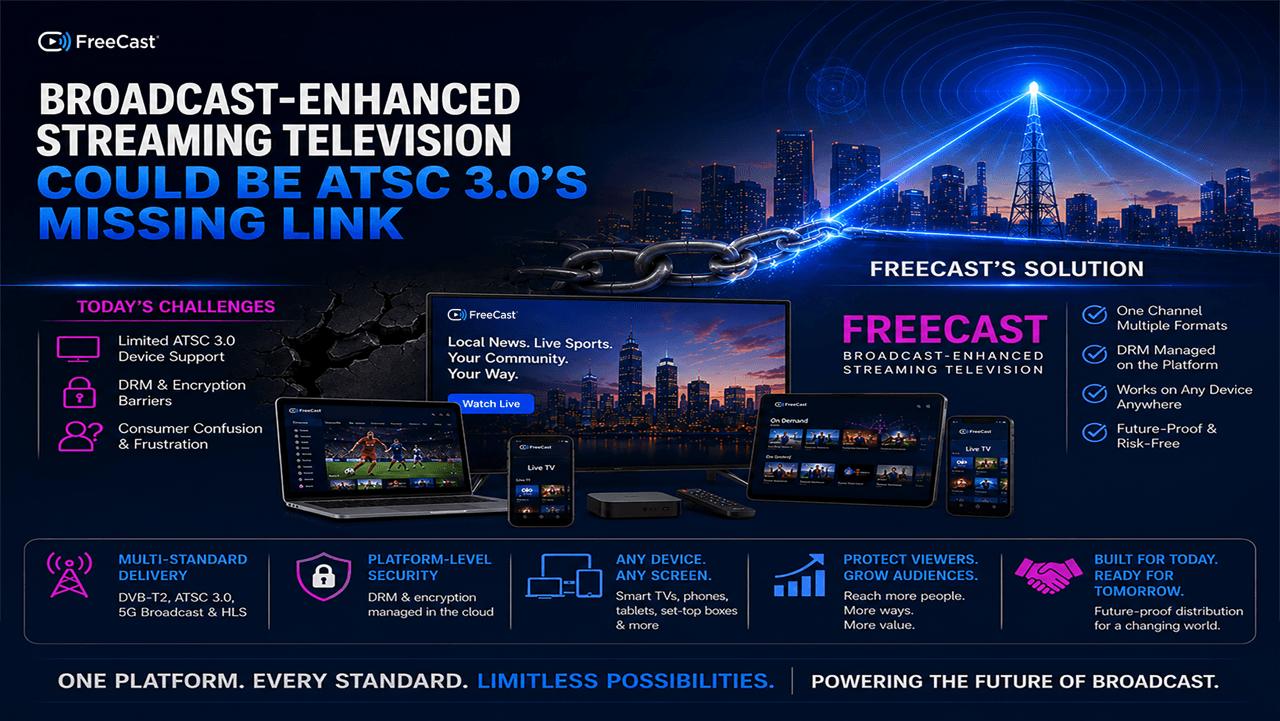
For broadcasters, our PaaS has the potential to tackle several of these problems at once. A key piece of this platform is FreeCast’s Broadcast-Enable Streaming Television technology, which makes a single linear channel available in multiple formats: DVB-T2 (current gen broadcast), ATSC 3.0, 5G Broadcast, and HLS (for streaming). This allows for reliable access to the same channel on a wide range of devices and formats, eliminating compatibility issues entirely.
This also allows DRM and other security features to be handled on the platform side rather than the device side, which solves the challenge around consumer hardware. This also allows consumers to buy hardware with confidence, knowing that the wrong choice won’t lock them out of their over-the-air channels.
With the industry faced with a thorny problem like the ATSC 3.0 transition obstacles, FreeCast’s Platform-as-a-Service represents a smart option, allowing programmers to play it safe without getting trapped in decision paralysis. By partnering with FreeCast, these companies can enjoy the advantages of being an early mover regardless of which standard ultimately wins out or what the endgame of the ATSC 3.0 transition saga looks like.
Not only does this remove the risk of a bad technology investment, it removes the need for the investment. FreeCast’s PaaS also provides a shared infrastructure platform, making the move for broadcasters to streaming a turn-key proposition, rather than a pricey one.