The Long Road from Rabbit TV to FreeCast
July 23, 2026
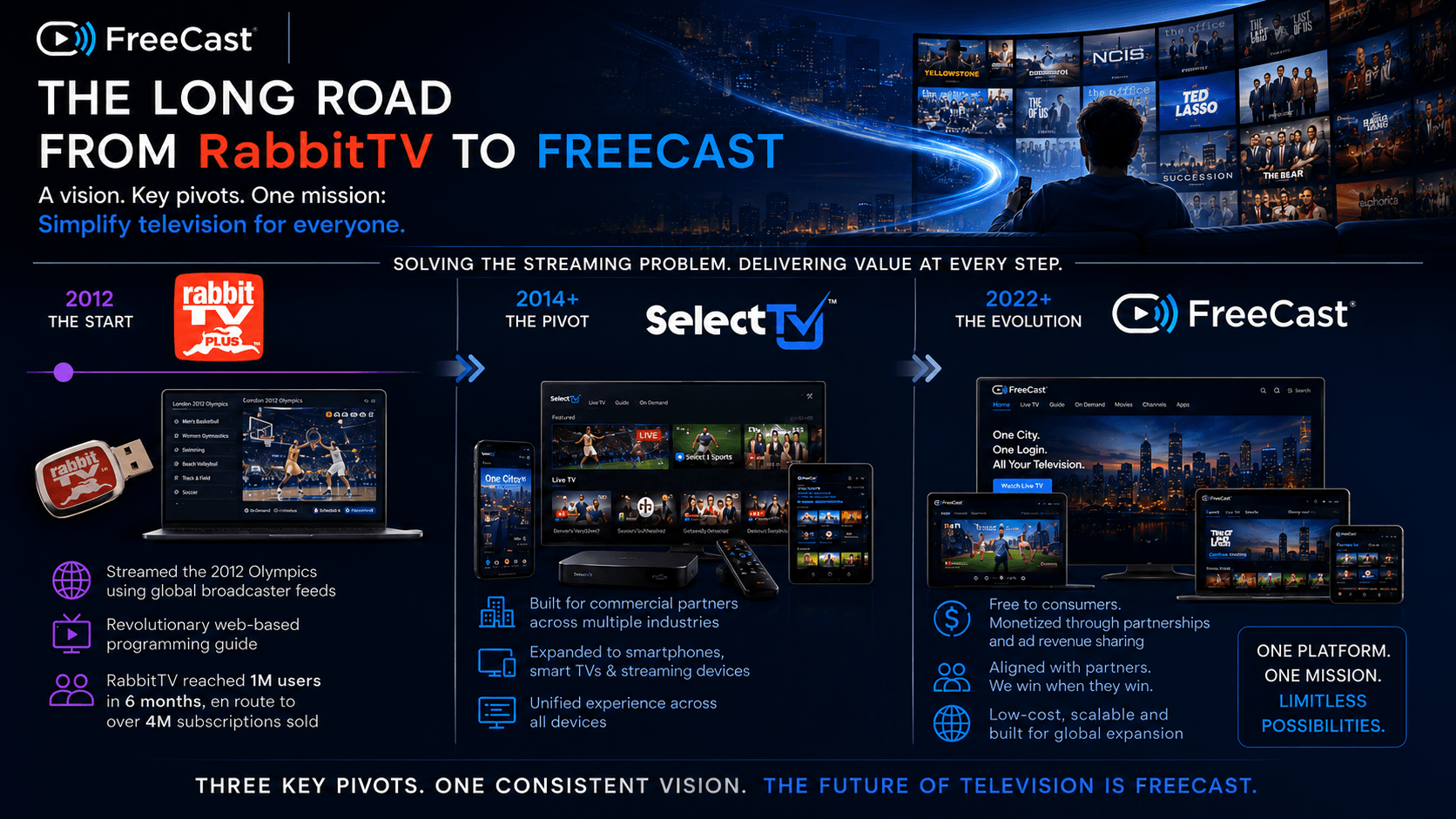
There’s too many streaming services. This has become an inescapable complaint as streaming overtakes linear TV, forcing more and more consumers to navigate a complicated and costly web of different services just to watch their favorite shows.
This is the problem that FreeCast the company was created to solve. Founded in 2011, one of FreeCast’s first efforts was to stream the 2012 Olympics. With multiple events occurring simultaneously, and multiple match-ups within each particular sport, FreeCast was able to leverage free streams from multiple global broadcasters to create a web-based electronic programming guide. This was revolutionary, because it allowed users to find and tune-in to any game they wanted, even those that weren’t carried by national broadcasters. For perhaps the first time, a viewer in America that wanted to see a more obscure match-up that wasn’t carried by NBC or another major broadcaster, could do so.
FreeCast quickly realized that this aggregated solution could go far beyond the Olympic games. Founded by William Mobley, one of the pioneers of streaming video, the company realized that eventually all television would be delivered the way they’d delivered the Olympics: via patchwork of different independent web-based providers. When this era arrived, a solution like FreeCast’s that allowed consumers to easily navigate what would otherwise be chaos, would be nothing short of essential.
This led to the launch of Rabbit TV later that year. At the time, subscription video on-demand was in its infancy. But already, some savvy consumers were starting to take notice that a handful of subscriptions—namely Netflix, Hulu, and Amazon Prime Video—could provide them with a wealth of content to watch at a fraction of the price of cable or satellite TV. “Cord-cutting” had become a thing.
That made FreeCast’s timing perfect, as rather than solving a problem that was merely on the horizon, the product could be positioned to enable consumers to save by making cord-cutting easier. To make cord-cutting accessible beyond only the tech-savviest of consumers at the time, FreeCast partnered with Telebrands, the “as seen on TV” company. Rather than depending on online sales, Rabbit TV was sold in stores via a USB stick, making it an easy buy and drawing in a new demographic of customers that weren’t being captured by Netflix and the other streaming services.
The Pivot to Commercial Partnerships with SelectTV
Rabbit TV was a successful product in the consumer market, reaching 1 million users in just six months, making the company one of the fastest-growing tech startups ever, en route to over 4 million subscriptions sold. During this time, FreeCast was already at work on a product that would broaden the company’s horizons further.
With SelectTV, FreeCast was building a product designed to integrate commercial partners as distributors. Multi-family housing, major brands and membership products, the hospitality industry, healthcare settings, student housing, and others would be able to offer a co-branded version of the product to their customers.
SelectTV was also designed to target a wider variety of devices. While Rabbit TV featured a web-based interface, SelectTV also supported smartphones, smart televisions, and other streaming set-top hardware. This was critical, because beyond just bringing an app to these platforms, this allowed SelectTV to offer a unified interface across all a consumer’s different devices.
While individual SVOD providers may have had some consistency across their apps on different devices and desktop web experience, that quickly broke down when it came to finding content across different apps and services, as different devices each had their own OS and interface. That “app-diving”, already a cumbersome process, was made infinitely more so.
Tearing Down the Paywall as FreeCast
In 2022, FreeCast began to offer its base service for free, for the first time. To highlight this fact, the service was rebranded, taking on the company name of FreeCast.
The company realized that the most reliable way to monetize the service was not through targeting consumers and charging users a fee, but rather by leveraging commercial partnerships, sharing ad revenues with organizations that could bring in large numbers of users at once.
With streaming prices on the rise, this took the burden off the end user, and created a monetization structure where FreeCast makes money when its partners make money.
Other platforms are provided and operated by big tech firms who are increasingly also in the media business, forcing programmers onto a playing field owned and controlled by a direct competitor. This is an inherent conflict of interest, and the platforms themselves are actively being manipulated based on their provider’s commercial interests. The result is often that programmers must pay to reach the very audience that they were supposed to be establishing a direct (-to-consumer) relationship with.
FreeCast’s platform, on the other hand, offers alignment. FreeCast makes money only when its partners do, entirely based on performance.
This low-cost approach also allows FreeCast to expand its reach. In addition to becoming an easy choice for partners: turn-key, low-risk, and almost immediately revenue-positive. This also positions the service for global expansion, particularly into emerging markets where free and low-cost services dominate.
For FreeCast, this allows the company to get itself out of the “retail” direct-to-consumer marketing business, and by extension, free its partners from this expensive and low-ROI game as well.
Lessons in the Journey
From the start, FreeCast has been driven by a powerful vision, directed towards a consistent goal. But every step along the way, particularly the major ones, have been informed by the lessons learned from doing.
With Rabbit TV, FreeCast proved a concept, while serving the need at the time: enabling easy and affordable cord-cutting and saving Americans hundreds of dollars a year on TV bills. With SelectTV, this evolved to serve consumers on a wider range of devices as media become more connected, interactive, and digital. With FreeCast, the company is positioned for a new global era of media: a post-linear TV, streaming-first world.
While perhaps not yet a household name, FreeCast has been on the cutting edge, not just of streaming technology but of the streaming business. Real world, practical considerations have helped shape the company’s product just as much as technical innovation has. This is a resource that FreeCast’s partners have the opportunity to take advantage of. Too many of the nation’s biggest media companies have fallen into the “follow the leader” trap, trying to copy Netflix’s strategy, and achieving no genuine advantage while sinking enormous sums into technology and marketing.
FreeCast’s mix of visionary leadership and in-the-industry experience make it a reliable partner for media companies of all sizes looking to navigate the transition from traditional television to streaming distribution.