The History of FreeCast: From Rabbit TV and SelectTV to Today
Streaming looks very different today than it did when FreeCast began.
There are more streaming services, more apps, more devices, and more ways to watch television than ever before. But with all of that choice came a familiar problem: finding what you want to watch can sometimes be harder than actually watching it.
That challenge has been at the center of FreeCast’s story from the beginning.
In FreeCast’s own history of the company, it traces its roots to 2011 and one of its first major efforts around the 2012 Olympic Games. The company built a web-based programming guide that brought together streams from multiple broadcasters, helping viewers find events that were otherwise spread across different sources. FreeCast’s history of the company describes that early effort as an important step toward the aggregation model that would later define the company’s direction.
The technology, products, and business model have evolved considerably since then, but the core idea has remained remarkably consistent: make a fragmented television experience easier to navigate.
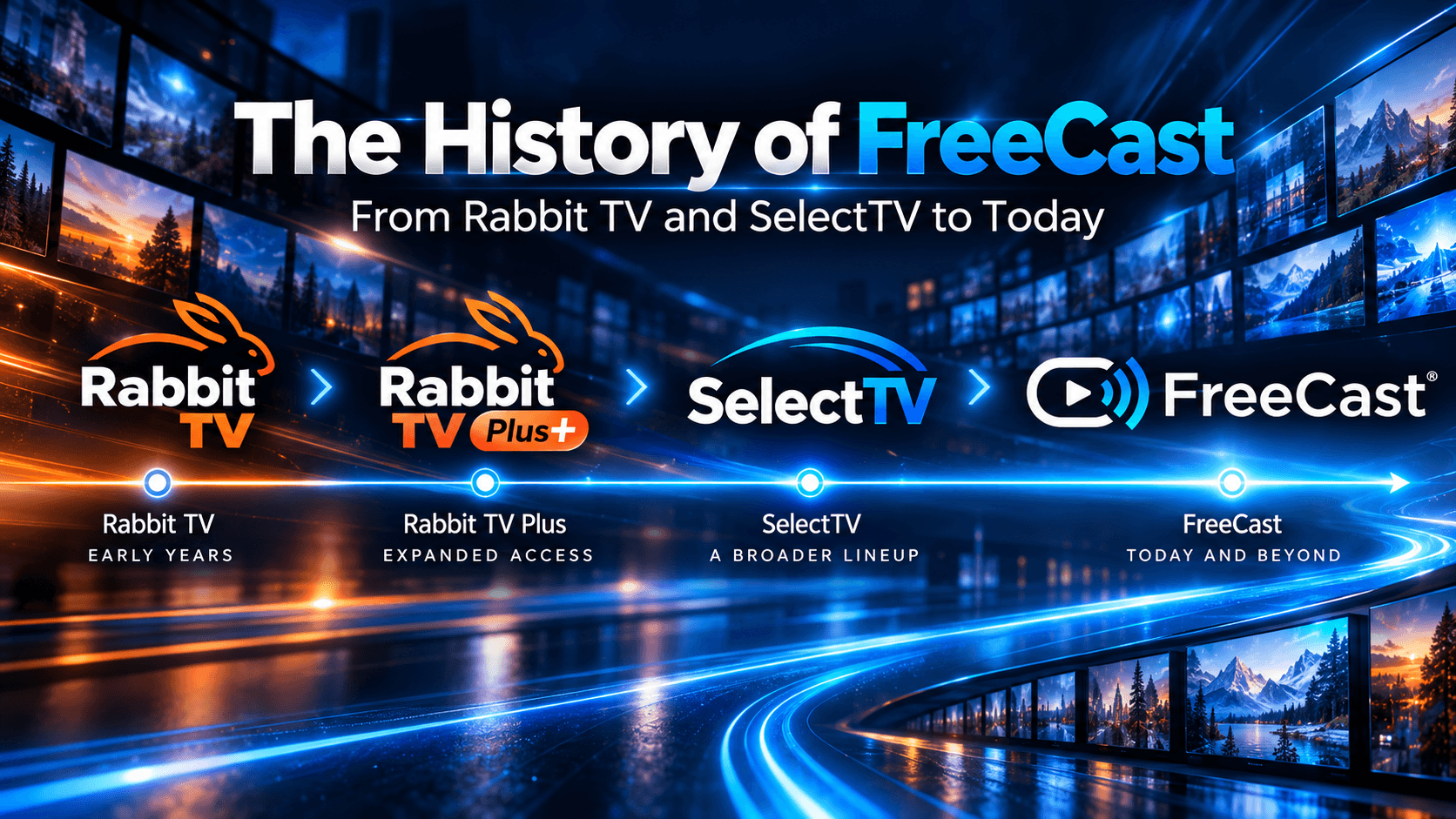
That journey has included several names longtime streaming viewers may remember well — Rabbit TV, Rabbit TV Plus, and SelectTV — before evolving into the FreeCast platform available today.
FreeCast Started with a Simple Idea
FreeCast was founded in 2011, when streaming was still a relatively new part of the television landscape.
According to FreeCast’s account of its early history, the company recognized during the 2012 Olympics that online television was already beginning to fragment across different broadcasters and websites. By organizing those streams into a single programming guide, FreeCast created an early example of the type of content aggregation that would later become much more important as streaming grew.
That experience led to a broader realization: if television continued moving online, consumers were eventually going to need help navigating a growing number of independent services.
That insight became the foundation for what came next.
Rabbit TV Brought Streaming Discovery to a Mass Audience
Later in 2012, FreeCast launched Rabbit TV.
A FreeCast SEC filing explains that the company initially licensed its technology to Telebrands, which distributed Rabbit TV memberships through retailers from 2012 through 2016.
For many consumers, Rabbit TV became recognizable because of the small USB device sold in retail stores. But the device itself was only part of the experience. The real product was the online service behind it, designed to help people find television and entertainment across a growing number of internet sources.
FreeCast’s company history says Rabbit TV reached one million users within its first six months and eventually surpassed four million subscriptions sold.
That early success showed there was significant consumer demand for a simpler way to navigate online television.
For many viewers, Rabbit TV was their first introduction to the idea that cutting the cable cord did not have to mean searching the internet one website at a time.
FreeCast still acknowledges that legacy today. Its current Rabbit TV page for former users describes Rabbit TV as the beginning of the company’s mission to simplify streaming and offers former Rabbit TV users a path into the modern FreeCast experience.
Rabbit TV Plus Carried the Experience Forward
Rabbit TV did not simply disappear when the original retail model changed.
Rabbit TV Plus became part of the next phase of the company’s consumer offering and continued serving the existing membership base while FreeCast developed newer products.
FreeCast’s SEC filings describe Rabbit TV and Rabbit TV Plus as predecessor services to SelectTV and the company’s later streaming products. Those filings also show how revenue from those legacy products eventually gave way to newer platforms as the business transitioned.
That makes Rabbit TV Plus an important bridge in the history of FreeCast.
Rather than viewing Rabbit TV, Rabbit TV Plus, SelectTV, and FreeCast as unrelated products, they make more sense as successive generations of the same broader idea: helping consumers deal with an increasingly complicated television marketplace.
SelectTV Expanded the Vision
In July 2016, the company took another major step.
According to a FreeCast SEC filing, the company began offering its technology directly to consumers under the SelectTV brand. Initially, SelectTV memberships were purchased and redeemed online. In October 2019, the company expanded SelectTV into a direct-to-consumer packaged “cord cutting kit” sold through television infomercials and ecommerce.
SelectTV represented a broader version of the concept that had started with Rabbit TV.
The marketplace was changing quickly. Streaming was moving beyond computers and into smart TVs, phones, tablets, and connected devices. Consumers were also beginning to accumulate more streaming subscriptions.
FreeCast’s company history describes SelectTV as the stage when the experience expanded to serve consumers across a wider range of devices as television became increasingly connected, interactive, and digital.
The problem was no longer simply finding online video.
It was figuring out how to organize a growing collection of services, subscriptions, channels, devices, and content sources.
SelectTV Became FreeCast
Another major transition came in 2022.
FreeCast’s SEC filings state that the company discontinued the SelectTV.com paid subscription service and packaged SelectTV Streaming TV Kits in October 2022. The consumer service was then rebranded under the FreeCast name, while SmartGuide was relaunched as a free-registration streaming media guide.
This was more than a branding change.
Rabbit TV had helped consumers navigate the early stages of cord-cutting. SelectTV expanded that idea as streaming moved onto more devices and services. FreeCast brought those experiences together under the company’s own name.
FreeCast’s 2026 history describes the transition directly: Rabbit TV proved the original concept, SelectTV expanded the experience, and FreeCast became the next stage of the company’s evolution for a streaming-first television market.
From Consumer Product to Streaming Platform
FreeCast’s evolution has continued beyond the consumer experience.
In recent years, the company has expanded the technology behind its streaming products into a broader Platform-as-a-Service model.
In a May 2026 letter, FreeCast CEO William Mobley described the company’s transformation from a recognizable direct-to-consumer streaming product into a commercialized Platform-as-a-Service ecosystem capable of supporting telecom operators, satellite companies, broadband providers, mobile carriers, multi-dwelling properties, and other consumer brands. Read the company’s “Behind the Curtain” update for the full explanation of that evolution.
That represents a significant expansion of the original idea.
The company is no longer focused only on helping an individual consumer organize streaming choices. Its technology is also designed to help other businesses distribute, manage, and monetize streaming experiences of their own.
The scale has changed, but the underlying challenge remains familiar: television is fragmented, and bringing those pieces together can create value for both viewers and the companies serving them.
A New Chapter as a Public Company
FreeCast entered another stage of its history in 2026.
On March 10, 2026, FreeCast became a publicly traded company on Nasdaq under the ticker symbol CAST. In reflecting on the milestone later that year, the company described becoming public as the beginning of a new era after more than a decade of developing streaming technology and infrastructure. Read A New Era for FreeCast as a Public Company for the company’s own account of the milestone.
FreeCast’s public-company update also emphasized that its underlying mission had remained consistent: simplifying streaming not only for consumers, but increasingly for businesses operating throughout the media industry.
The Mission Has Stayed Surprisingly Consistent
Rabbit TV arrived when cord-cutting was still unfamiliar to many consumers.
Rabbit TV Plus helped carry those early users forward.
SelectTV arrived as streaming spread across more devices and consumers began accumulating more subscriptions.
FreeCast now operates in a world where viewers may have free streaming channels, live television, local stations, sports packages, premium subscriptions, and on-demand libraries all competing for their attention.
The names changed because television changed.
The central problem did not.
FreeCast has spent its history trying to make an increasingly fragmented television marketplace easier to navigate — first through content discovery, then through aggregation and subscription management, and now through technology designed to support both consumers and distribution partners.
From Rabbit TV to Rabbit TV Plus, from SelectTV to FreeCast, each chapter has been another stage in that evolution.
And after more than a decade of change in streaming, the question behind the company remains remarkably familiar:
How can watching television be simpler?