What Does Free Streaming Actually Mean?
“Free streaming” sounds pretty simple. You press play, you watch, and you do not pay a monthly subscription.
Most of the time, that is exactly what it means.
But free streaming can take several different forms. It might be a live channel supported by commercials, a movie you can watch on demand, a local broadcast channel, or an entire library of shows available without a traditional cable package.
The important thing to understand is that “free” does not always mean the content has no business model behind it. In many cases, advertising pays for the programming instead of the viewer paying a monthly fee.
Once you understand that difference, the growing world of free streaming becomes much easier to navigate.
What Counts as Free Streaming?
At its simplest, free streaming is video content you can watch without paying a recurring subscription fee for that specific service or program.
Live streaming TV channels
Free movies and TV shows
News and entertainment channels
Some sports programming
Local television
Ad-supported on-demand libraries
Free streaming services supported by advertising
Some services ask you to create a free account. Others let you start watching immediately. You may see commercials along the way, just as you would with traditional broadcast television.
The exact experience differs from service to service, but the basic tradeoff is usually easy to understand: instead of paying with a monthly subscription, you watch advertising that helps support the programming.
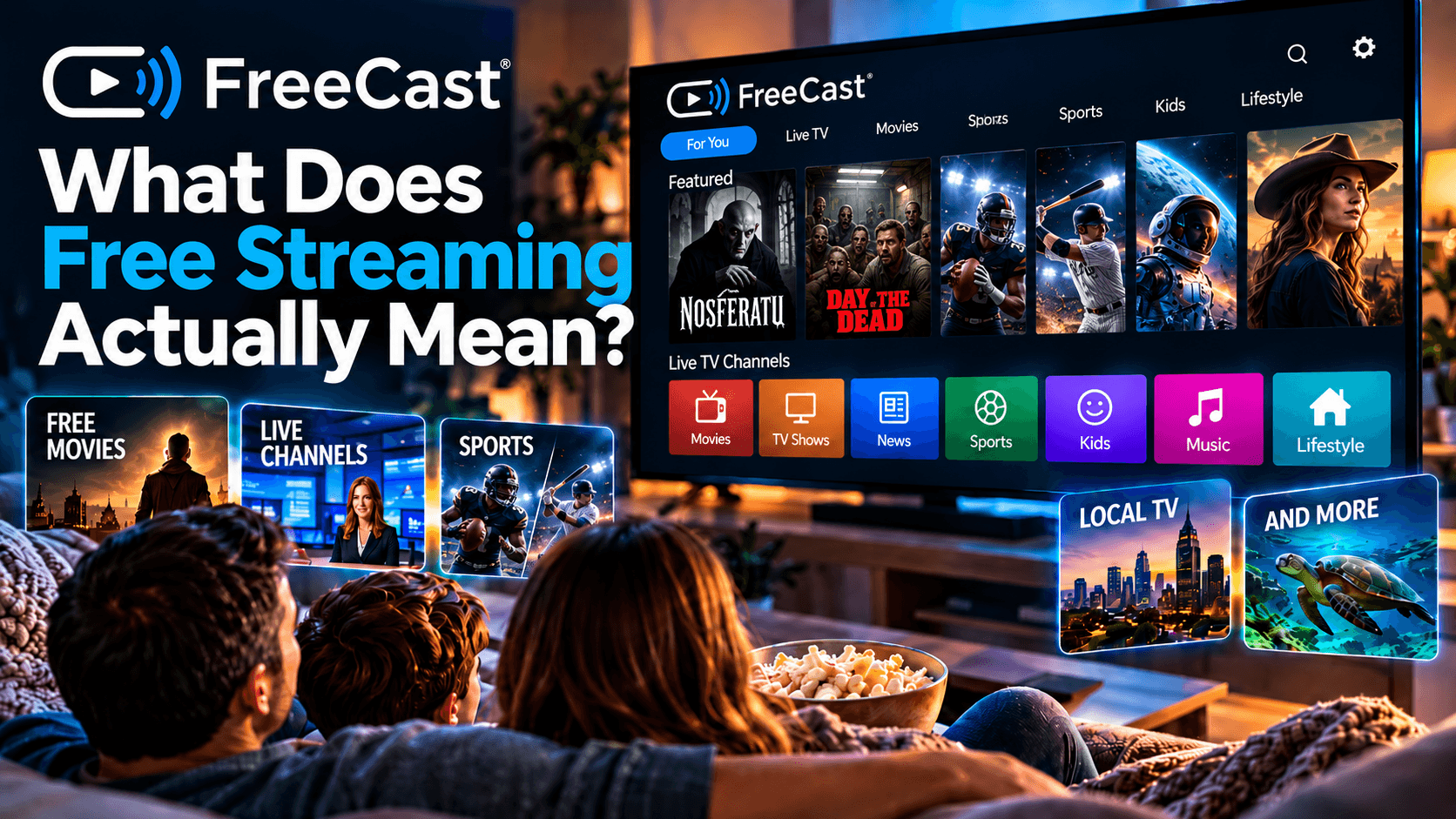
On FreeCast, viewers can currently access more than 500 free streaming channels covering categories such as movies, news, sports, entertainment, lifestyle, kids programming, music, and more.
How Can Streaming Be Free?
Someone still has to pay for the programming, technology, and distribution behind a television channel or movie library.
Free streaming simply changes who pays.
A large part of the free streaming industry is supported by advertising. A company earns money when viewers watch ads, and some of that revenue can then flow back to the content owners and distribution partners.
If you grew up watching broadcast television, the idea is not really new. You did not receive a monthly bill from your local television station just to watch a sitcom or the evening news. Commercials helped support the programming.
Streaming brought that familiar model to internet-connected TVs, phones, tablets, computers, and streaming devices.
That is why many viewers are discovering they can build a surprisingly large entertainment lineup before adding another paid subscription.
What Are FAST Channels?
You will probably see the term FAST more often as free streaming grows.
FAST stands for Free Ad-Supported Streaming Television.
The easiest way to think about a FAST channel is that it feels more like traditional television than a typical on-demand service. You open a channel and something is already playing. There may be a schedule, commercial breaks, and programming that continues throughout the day.
Deloitte distinguishes FAST from traditional ad-supported video on demand by noting that FAST services include live-style television programming, while AVOD generally lets viewers select a show or movie whenever they want to watch it.
FreeCast’s SmartGuide brings FAST channels together with on-demand programming and connected subscription services so viewers can search across different types of television from one place.
What Can You Actually Watch for Free?
This is where things get interesting.
Free streaming is no longer limited to a handful of old television shows or obscure internet channels. Depending on the service and the rights available, viewers can find movies, television series, live channels, news, sports, music, lifestyle programming, and more.
Free Movies and TV Shows
Free on-demand viewing works much like the streaming services people already know.
You choose a movie or television episode, press play, and watch it when you want. The main difference is that ads may appear during the program.
FreeCast’s on-demand experience connects viewers with a large catalog of movies and television programming and currently promotes access to more than 500,000 movies, shows, and other titles across the broader platform.
That can be especially useful when you are looking for something specific rather than browsing through another monthly subscription.
Free Live TV
Free streaming can also recreate some of the experience people miss from cable: turning on the television and simply seeing what is on.
FreeCast’s streaming channel lineup includes hundreds of live channels across movies, sports, news, TV, lifestyle, kids programming, music, and other categories.
That makes free streaming useful for both types of viewers: people who know exactly what they want and people who just want to browse.
Sports and Special Events
Sports are a little more complicated.
Some games are available through free broadcasts or free streaming options, while others require a particular network, streaming subscription, or league package.
That is why the question should usually be, “Where is this game available?” rather than assuming every game is either free or paid.
For example, our guide to watching NFL games without cable explains how the viewing source can change based on the matchup, market, and broadcast rights.
The same thing happens in baseball. Our guide to watching the MLB playoffs without cable breaks down how different postseason rounds move between networks and streaming services.
Free streaming can absolutely be part of a sports fan’s setup. It just may not cover every game.
Is Free Streaming Really Free?
Yes, but it helps to know what you are getting.
A legitimate free streaming service should not suddenly surprise you with a monthly bill for content that was advertised as free.
You may see advertising. You may need to register. Certain premium channels or add-ons may cost extra. And local television may require compatible equipment depending on how you want to receive and distribute those channels.
FreeCast, for example, offers hundreds of free streaming channels and a large free content library while also offering optional paid packages for viewers who want additional programming. See the FreeCast FAQ for more detail.
That distinction matters.
Free streaming does not mean everything on the internet suddenly becomes free. It means you can build a meaningful portion of your viewing experience without stacking one paid subscription on top of another.
Free Streaming vs. Paid Streaming
You do not really have to choose one side.
For most households, the better approach is probably a mix.
Start with what you can watch for free. Then add paid services only when they offer something you genuinely want.
Maybe you use free channels for everyday television and keep one paid service for a favorite series. Maybe you add a sports package during part of the year. Maybe you rotate subscriptions depending on what you are watching.
FreeCast’s subscription tools are designed around that kind of flexibility, allowing viewers to connect and manage streaming services alongside free content instead of treating every app as a completely separate television experience.
The goal is not to collect as many subscriptions as possible.
It is to make sure the subscriptions you do pay for are actually useful.
Why Is Finding Free Content Still So Difficult?
This may be the biggest problem in streaming today.
There is more content available than most people could ever watch. The challenge is figuring out where it lives.
A movie might be free on one service, included with a subscription on another, and available as a rental somewhere else. A television series can move between platforms. Sports rights can change by game. Local channels depend on where you live.
That means people spend a surprising amount of time moving between apps and searching for the same title.
FreeCast has been working on that problem since the early days of Rabbit TV and SelectTV. The company’s history shows that content aggregation and helping viewers navigate fragmented streaming options have been central ideas since its earliest products.
Today, SmartGuide continues that approach by organizing free channels, paid subscriptions, and on-demand content into one searchable experience.
What About Free Local TV?
Local television is another part of the free-viewing picture.
Depending on where you live, broadcast channels can provide local news, sports, weather, and major network programming without an ongoing monthly television fee.
FreeCast’s local TV tools allow viewers to check what channels may be available in their area and explore options for bringing those broadcasts into their overall viewing setup.
That is another reason “free streaming” has become a broader concept than simply opening a free movie app.
For some households, the combination of free streaming channels, on-demand entertainment, and local television can cover a significant amount of everyday viewing.
How FreeCast Brings Free and Paid Streaming Together
Free streaming gives viewers more choices. Unfortunately, more choices can also create more confusion.
That is where FreeCast fits into the picture.
Instead of asking viewers to remember which app carries which movie, channel, show, or subscription, FreeCast brings free streaming channels, on-demand entertainment, local viewing options, and connected subscriptions into a broader discovery experience.
You can browse free streaming channels, explore movies and shows on demand, connect your streaming subscriptions, or use SmartGuide to make finding what to watch easier.
And that may be the simplest answer to the original question.
Free streaming means you can watch real television, movies, shows, and other programming without automatically adding another monthly subscription.
The content is not magically free to produce. Advertising and other business models help pay for it.
But for the viewer?
Sometimes you really can just press play.